





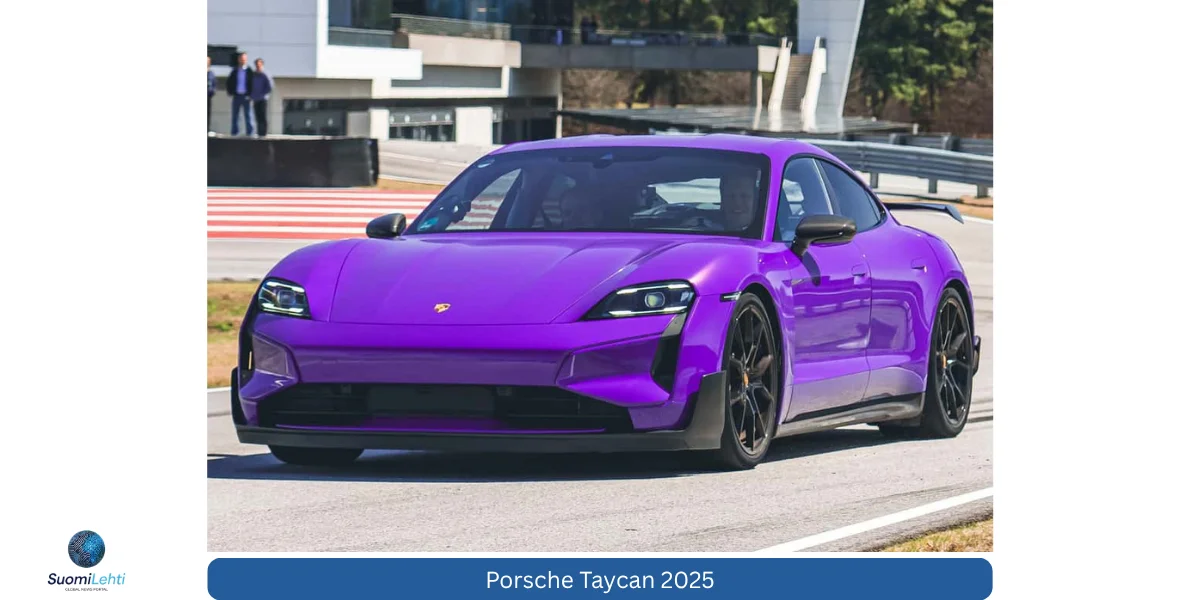
The Porsche Taycan has spent five years proving that an electric car can still feel unmistakably like a Porsche, and the 2025 model year is the biggest update the car has had since launch. Rather than a cosmetic refresh, Porsche went after the parts that matter most to owners: range, charging speed and everyday usability. If you’re shopping for a premium electric sports car right now, here’s a practical, no-fluff look at what’s actually changed and whether the 2025 Taycan deserves a spot on your shortlist.
What’s new for the 2025 model year
The most significant update sits under the skin rather than on it. Porsche fitted the Taycan with new battery cells offering higher capacity, paired with a lighter, more powerful rear motor and a refined pulse inverter. Together, these changes push range up by as much as 32 percent over the outgoing model, a genuinely large jump for a mid-cycle update rather than an all-new generation.
Beyond the powertrain, Porsche also broadened standard equipment across the range. Entry-level trims now come with adaptive air suspension as standard, something previously reserved for pricier variants. Every trim gets a wireless smartphone charging tray, charging ports on both sides of the car, ambient lighting, a heated steering wheel and a lane-change assist system. Turbo models also gain a push-to-pass style overboost function for short bursts of extra performance.
One notable trim-level change: the mid-range GTS variant was temporarily dropped from some early 2025 configurations before returning later in the model year, so it’s worth double-checking current availability with your local dealer.
Trim lineup and body styles
The Taycan is sold in two body styles: the traditional four-door sedan and the more practical Cross Turismo wagon, which adds extra ride height and cargo space for a more everyday-friendly package. Across both, the trim walk looks roughly like this:
- Taycan (base) – single motor, rear-wheel drive, 402 horsepower
- Taycan 4 – dual motor, all-wheel drive, more grip and traction
- Taycan 4S – stronger dual-motor setup with 429-plus horsepower depending on battery
- Taycan GTS – sportier tune, around 690 horsepower
- Taycan Turbo – high-performance all-rounder for daily use
- Taycan Turbo S – near range-topping performance with carbon-ceramic brakes standard
- Taycan Turbo GT – the flagship, with up to 777 horsepower continuously and 1,019 horsepower on overboost
With eight distinct powertrain combinations on offer, working out which Taycan actually suits your budget and needs can take some research, so it’s worth test-driving at least two trims before committing.
Performance and specs
Every Taycan delivers the instant torque that defines electric performance cars, but the spread between the base model and the Turbo GT is enormous:
- Power output ranges from 402 horsepower in the base rear-drive car to 777 horsepower (1,019 on overboost) in the Turbo GT with the Weissach package
- Torque spans from roughly 272 lb-ft at the entry level up to 855 lb-ft at the top end
- 0-60 mph times range from around 4.5 seconds in the base car down to just 2.1 seconds in the quickest Turbo GT configuration
- Despite weighing over 5,000 pounds in some configurations, the Taycan’s low centre of gravity and air suspension give it handling that belies its mass
Porsche also introduced an Active Ride system on higher trims, which actively leans the body into corners and smooths out rough surfaces — a genuinely unusual feature for a production sedan and one that further separates the Taycan from rivals on driving feel.
Range and battery options
Range has historically been the Taycan’s weak point next to some rivals, and the 2025 update directly targets that criticism. Two battery options are available:
- A standard battery delivering an EPA-estimated 252 to roughly 274 miles depending on configuration
- The larger Performance Battery Plus, which pushes EPA range up to 318 miles in the most efficient rear-drive trim
That 318-mile figure is a substantial jump from the outgoing model’s 246-mile ceiling, and it’s enough to make the Taycan genuinely competitive with rivals that previously held a clear range advantage. As with any EV, real-world range will vary with speed, temperature and driving style, and cold weather in particular can meaningfully reduce the number you see on the trip computer.
Charging: the Taycan’s biggest technical advantage
The Taycan’s 800-volt electrical architecture remains one of its strongest selling points, even five years after launch, because most rivals still use 400-volt systems. In practice, this means:
- Peak DC fast-charging speeds of up to 320 kW under ideal conditions on a compatible charger
- A standard 150 kW DC/DC converter that improves charging speed even on more common 400-volt networks
- Meaningfully shorter stops on road trips compared with many competitors, particularly on longer highway journeys
For anyone doing regular long-distance driving, this charging speed advantage is one of the more tangible, everyday-relevant reasons to choose a Taycan over a rival with a larger but slower-charging battery.
Pricing across the range
Pricing spans an unusually wide bracket depending on trim, battery and body style. Entry-level pricing starts at roughly $99,400 to $100,300 for the base sedan, climbing steadily through the range:
- Base sedan: from around $99,400–$100,300
- Base Cross Turismo: from around $111,000–$112,000
- Taycan 4S sedan: around $118,500
- GTS models: around $147,900–$149,800
- Turbo trims: around $173,600–$176,300
- Turbo S trims: around $209,000–$213,695
- Turbo GT and Turbo GT with Weissach Package: from around $230,000, climbing past $275,000 with a heavily optioned build
It’s worth noting most of these figures exclude Porsche’s destination fee, and the options list is genuinely vast — a polarising 10.9-inch passenger display, a rear-seat climate screen and soft-close doors are all available as extras that can add tens of thousands of dollars to a build if you’re not careful in the configurator.
Interior and technology
Inside, the Taycan keeps its driver-focused layout while pushing the digital experience further. The latest Porsche Driver Experience interface includes a curved digital instrument cluster, a large central touchscreen and an optional polarised passenger display that shows content invisible to the driver while driving — a clever solution to a common in-car distraction problem. A smaller optional rear climate-control screen is also available for back-seat passengers.
Material choices have expanded too, with leather-free interior packages now offered as an extra-cost option across Standard, 4 and 4S trims, reflecting growing demand for more sustainable interior materials without compromising on perceived quality.
Who should actually buy a 2025 Taycan
The Taycan makes the most sense for buyers who want genuine sports-car dynamics and don’t want to compromise that for an electric powertrain. It suits daily commuting duty comfortably, and the extended range on the Performance Battery Plus option makes longer trips far more realistic than on the outgoing model. Families or buyers who need more cargo flexibility should look closely at the Cross Turismo body style, which trades none of the driving character for noticeably more practicality.
Buyers chasing maximum range for the money, rather than outright driving engagement, may still find better value elsewhere in the EV market — the Taycan’s core appeal has always been how it drives, not how far it goes on a single charge, even with this year’s improvements.
Frequently asked questions
How much has range improved for the 2025 Porsche Taycan?
EPA-estimated range has increased by up to roughly 32 percent over the previous model, topping out at around 318 miles on the Performance Battery Plus in the base rear-drive trim.
How fast can the 2025 Taycan charge?
On a compatible 800-volt DC fast charger, peak charging speed reaches up to 320 kW, allowing a 10 to 80 percent charge in around 20 minutes under ideal conditions.
What’s the fastest Porsche Taycan for 2025?
The Turbo GT with the Weissach Package is the quickest, producing up to 777 horsepower continuously and 1,019 horsepower in overboost mode, with 0-60 mph achievable in around 2.1 seconds.
How much does the 2025 Porsche Taycan cost?
Pricing starts at roughly $99,400 for the base sedan and rises to more than $230,000 for a Turbo GT with the Weissach Package, before options and destination fees.
The bottom line
The 2025 Porsche Taycan is the most complete version of this car yet. A genuine range increase, faster real-world charging and a longer list of standard equipment address the criticisms levelled at earlier model years, while the driving experience — the whole reason to buy a Taycan in the first place — remains as sharp as ever. It’s still an expensive way into electric motoring, but for buyers who value how a car feels on the road as much as its spec sheet, few electric vehicles currently match it.